There’s usually a moment when the idea of camping comes up and someone immediately shuts it down.
Not aggressively. Just confidently.
“We’re not really a camping family.”
It’s often said the same way people say they don’t do scary movies or early mornings. It feels like a personality trait, not a preference.
And honestly, for a long time, that made sense.
Camping had a reputation. It meant sleeping on the ground, hoping for the best, and pretending that being slightly uncomfortable was part of the charm.
But here’s what’s changed.
Camping isn’t just one thing anymore.
And that’s exactly why more families, especially the ones who swore they’d never do it, are starting to reconsider.
Camping Has Quietly Evolved
What’s different now isn’t just the gear. It’s the flexibility.
Camping today exists on a spectrum, and most families are landing somewhere in the middle, not at the extremes.
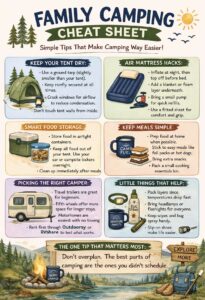
On one end, you still have traditional tent camping. And for many, it’s become far more approachable than it used to be. A simple setup with a tent like the Coleman Sundome Tent and a comfortable air mattress from Intex can feel surprisingly manageable, especially at a well-equipped campsite.
But here’s where things really open up.
If sleeping on the ground still feels like a hard no, there are plenty of other ways to experience camping without giving up comfort.
RV camping has become one of the most popular options for families who want the outdoor experience with a layer of convenience built in. Travel trailers, fifth wheels, and motorhomes allow you to bring your own space with you, often including beds, kitchens, bathrooms, and even air conditioning.
For families who don’t own an RV, rental platforms like Outdoorsy and RVshare make it easy to try it out without a long-term commitment.
You can even have an RV delivered and set up at your campsite, which feels a little like showing up to camping… already winning.
Then there’s glamping, which has changed the game entirely. Platforms like Hipcamp and Glamping Hub offer stays that range from safari tents and yurts to fully styled cabins and domes.
It’s still the outdoors, just without the stress of figuring everything out from scratch.
The takeaway here is simple.
You don’t have to do camping the hard way to still count it as camping.
Why It Ends Up Feeling So Different
One of the biggest surprises for families trying camping for the first time is how different the pace feels.
There’s no pressure to constantly move. No rigid schedule. No feeling like you need to plan every hour to make the trip worth it.
Instead, the day unfolds on its own.
Kids find ways to stay busy without needing to be entertained. Time stretches in a way that feels unfamiliar at first, then oddly refreshing. Even simple things, walking a trail, sitting by the fire, cooking together, start to feel like enough.
There’s also something about being outside for extended periods that shifts the energy of the entire family.
It’s quieter. Slower. Less reactive.
And while it may not look impressive on paper, it tends to feel better in real life.
Where Families Are Going
One of the biggest misconceptions about camping is that it requires a big, complicated trip.
In reality, some of the best experiences happen close to home.
State parks are one of the easiest ways to start. Systems like Tennessee State Parks, California State Parks, and Florida State Parks offer well-maintained campsites with restrooms, showers, and family-friendly layouts.
They remove a lot of the uncertainty, which makes them ideal for beginners.
If you’re ready to branch out, there are also some incredible, more unique experiences available.
National parks like Great Smoky Mountains National Park, Yellowstone National Park, and Zion National Park offer a mix of scenery, accessibility, and structured camping options.
For something different, browsing Recreation.gov can lead to hidden gems, from lakeside campsites to forest cabins and scenic overlooks.
And if you’re leaning more toward the glamping side, platforms like Airbnb often feature unique stays like treehouses, A-frame cabins, and converted vintage campers.
What You Actually Do (And Why It Works)
This is usually where people hesitate.
“What are we going to do all day?”
The answer ends up being both more and less than expected.
More time outside. Less structure.
Hiking becomes less about distance and more about exploring. Kids naturally find ways to stay engaged, whether it’s collecting rocks, playing near water, or simply being in a different environment.
Classic camping activities still hold up for a reason.
Making s’mores. Playing games. Sitting around talking without distractions.
None of it feels forced.
And without the constant pull of screens, kids tend to stay engaged longer than you’d expect.
The Small Upgrades That Change Everything
Camping doesn’t have to be complicated, but a few thoughtful additions can make it significantly easier.
Lighting is one of the biggest ones. A lantern from Coleman helps avoid the nightly scramble of trying to find everything in the dark.
Power is another. A portable option from Jackery allows you to keep devices charged without adding stress.
And simple organization, knowing where things are when you need them, can make the difference between a smooth experience and a frustrating one.
These aren’t about overpacking.
They’re about making things easier.
If You’ve Always Said “That’s Not Us”
Here’s the part worth reconsidering.
You don’t have to commit to becoming a camping family. You don’t have to love every part of it. And you definitely don’t have to do it in a way that feels uncomfortable.
Start small.
Try a nearby state park. Book a glamping stay. Rent an RV for a weekend and see how it feels.
Think of it less as a lifestyle change and more as trying something new.
Because for a lot of families, the biggest surprise isn’t that everything goes perfectly.
It’s that it doesn’t need to.
The Takeaway
Camping isn’t about doing it right.
It’s about doing it in a way that works for you.
And once you realize how many different ways there are to make that happen, it starts to feel a lot more possible.
Even if you’ve always been the family that said you’d never try it.